


 See our offers

What is a phototype?
A phototype refers to the way your skin reacts to sun exposure. It takes into account several criteria: the natural color of skin, eyes and hair, the ability to tan, the tendency to sunburn, and the amount of melanin produced.
This classification, developed by Harvard Medical School dermatologist Dr. Thomas B. Fitzpatrick, is now the international benchmark for aesthetic medicine and dermatology. It distinguishes six phototypes, from the lightest to the darkest skins.
Source: NewBeauty – “How to Determine Your Skin Type on the Fitzpatrick Scale”.
Matignon’s phototype: a made-to-measure diagnosis.
At Matignon, every patient receives a preliminary medical consultation during which the doctor :
✔ Evaluates your phototype according to the Fitzpatrick classification.
✔ Analyzes the quality, reactivity and history of your skin.
✔ Identifies the treatments best suited to your profile.
✔ Customize technical parameters to guarantee safety and efficiency.
This approach enables us to offer each patient a secure, tailor-made treatment path, whether it’s a peel, laser treatment, rejuvenation treatment or body contouring procedure.
Why should you know your phototype before undergoing beauty treatments?
Phototype is more than just cosmetic information: it’s an essential medical parameter for adapting each treatment.
Many techniques used in aesthetic medicine – laser, peeling, photorejuvenation, microneedling – interact directly with melanin. Darker skin, richer in pigment, may react differently than lighter skin, with a higher risk ofpost-inflammatory hyperpigmentation if treatment is not adapted.
According to dermatologist Dr Marianna Blyumin-Karasik, phototypes III to VI require more conservative settings for lasers and peels, to limit the risk of pigmentation (Source: NewBeauty).
Knowing your phototype allows you to :
✔ Choose the treatments best suited to your skin’s sensitivity.
✔ Adjust technical parameters (laser power, acid concentration, …).
✔ Anticipate the aftermath of treatment and possible side effects.
✔ Optimizing results in complete safety.
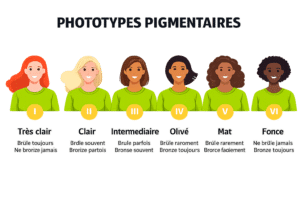
The Fitzpatrick classification distinguishes six skin phototypes, from the lightest to the darkest, according to their reaction to the sun and their ability to tan. Click on each phototype below to discover its characteristics.
Phototype IP
Very fair
skin
, often associated with red or blond hair, light eyes and numerous freckles. This skin systematically burns in the sun and never tans.
Phototype IILight skin
, blond to chestnut hair, light to hazel eyes. Burns easily and tans only slightly.
Phototype IIPale
to slightly matte
skin
, chestnut to brown hair. It sometimes burns but gradually tans.
Phototype IVMatte skin
(typical of Mediterranean or Latin American complexions), brown hair, dark eyes. Rarely burns, but tans easily.
Phototype VP
dark brown
skin
(often found in people of Middle Eastern, North African or South Asian origin). It rarely burns and tans strongly.
Phototype VIP
Black, melanin-rich
skin
. It hardly ever burns.
The higher the phototype, the more melanin the skin contains, a natural pigment that protects against UV rays. Conversely, phototypes I and II are more exposed to sunburn, premature aging and skin cancer.
Knowing your skin means knowing how to enhance it.
By understanding your phototype, you can choose treatments that are truly adapted to your skin type, maximizing the benefits and minimizing the risks. It’s also common sense: before transforming, you need to know.
At Matignon, our doctors will work with you to understand your skin and build an aesthetic protocol that suits you.
👉 Want to know more about your skin?
Make an appointment.Articles that might interest you

Treatments That Don’t Require Time Off: What Works for Summer
In the summer, our schedules open up, but the desire to “get away” for a few days to recover from a treatment doesn’t go away nearly as much. The good news is that some cosmetic treatments don’t require any interruption to daily life.
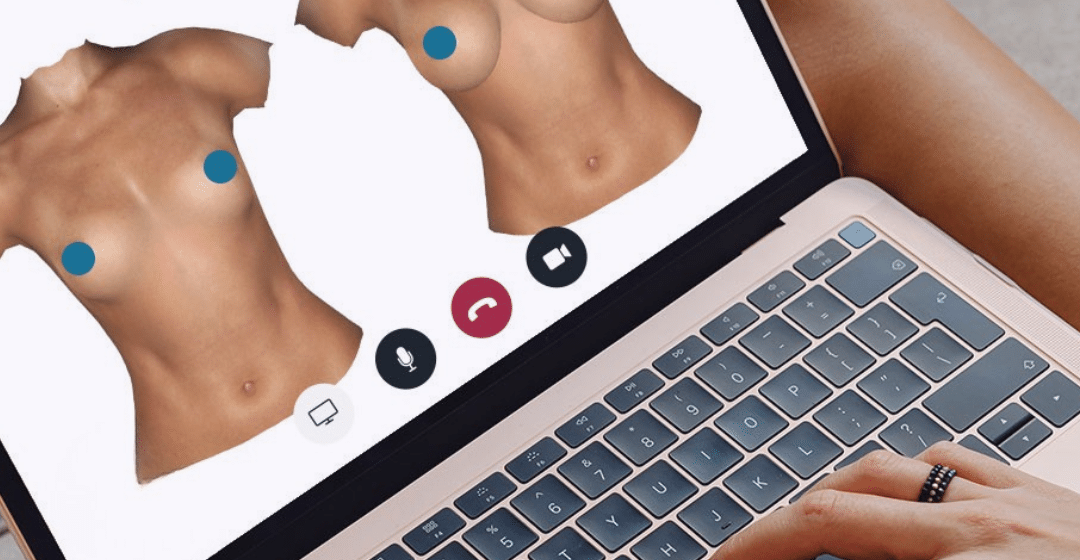
Crisalix: visualize a cosmetic surgery project for better understanding and decision-making
Thanks to advanced 3D simulation technology, Crisalix enables surgical treatment to be projected directly onto the patient's morphology. A tool for understanding and dialogue, integrated at Matignon to support informed, realistic decision-making.